Skip to content

Virtues for a Protocol Society

TalkNathan Schneider
Virtues for a Protocol Society

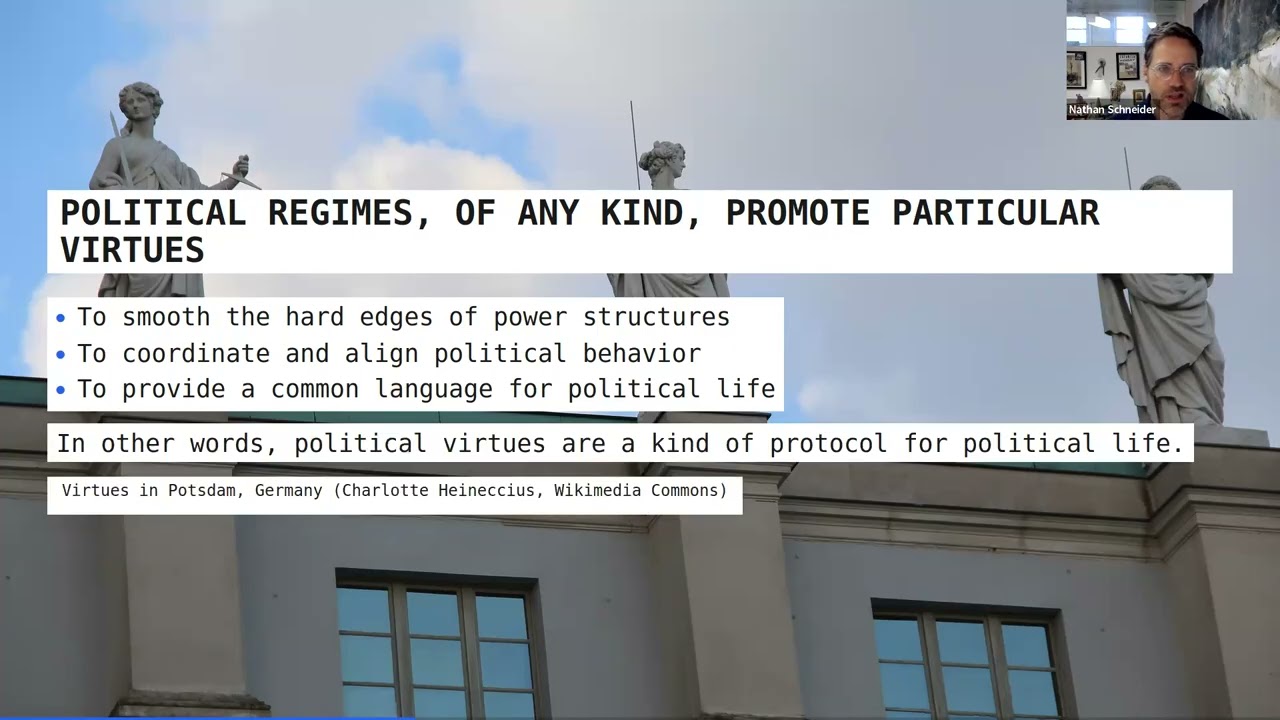
Nathan Schneider presents preliminary research, drawn from a forthcoming book, that treats protocols as a political order requiring its own set of civic virtues, analyzing text from 'The Protocol Reader' and 'For Protocols' (a mix of LLM-assisted and manual coding of 73 candidate terms) to find that adaptability, tension management, accessibility, temporal awareness, and design emerge as the most frequent and central virtues. He argues protocol societies uniquely demand tolerance for tension and co-design participation (rather than top-down implementation), and closes by questioning how such virtues get inculcated—pointing to practices like protocol fiction, protocol watching, and symposium pedagogy itself as mechanisms, while cautioning against uncritically embedding incentive-alignment as a default virtue.

Related resources

Talk

Group Brains: Minds Made of People

Kaliya Young presents her Protocol Institute-funded research on the IETF as a 'group brain' — a durable collective cognition combining a memory substrate (the data tracker, RFC series, mailing lists) with a human 'knowing' culture (rough consensus, birds-of-a-feather sessions, sortition-based leader selection) that together produce capacities no individual member holds. She extends the framework to Wikipedia and DAOs as comparative cases, introduces the concept of a 'group membrane' (who's in/out and how boundaries harden toward power), and argues AI should augment rather than replace human group cognition, positioning group-level alignment as a missing middle between individual and humanity-wide AI alignment debates.

Kaliya Young

Talk

Markets and the Journey to Neutrality

Nicholas Fett traces the history of market neutrality from 1889 Oklahoma land runs and Adam Smith's moral sentiments through Keynes, the Mont Pelerin Society, and into crypto, arguing that protocols designed to be neutral (Bitcoin's decentralization, Ethereum's 'crops' ethos) inevitably get captured by economic incentives like mining and block-builder centralization. He uses the 'tunnel' and 'one more lane' analogies to argue that building for neutral principles without a defined societal goal leads to outcomes divorced from original intentions, and that protocol designers must instead encode explicit purpose rather than chase an unattainable neutral equilibrium.

Nicholas Fett

Talk

Proliferation of Intelligence: Business and Hyper Learning Machines

Krishnakumar Gurumurthy argues that AI's frontier capabilities are outpacing business models built on human labor, creating a socio-economic gap disguised as a technical one. He proposes discretizing business processes into indivisible functional units, mapping them to appropriate AI techniques (neural operators, transformers, RL, etc.), and building a new enterprise stack with guardrails and trust architecture—drawing an extended analogy to how electricity safety standards (insulation, circuit breakers, licensed electricians) evolved to argue for similar AI containment, validation, and certification regimes.

Krishnakumar Gurumurthy