Skip to content

Group Brains: Minds Made of People

TalkKaliya Young
Group Brains: Minds Made of People

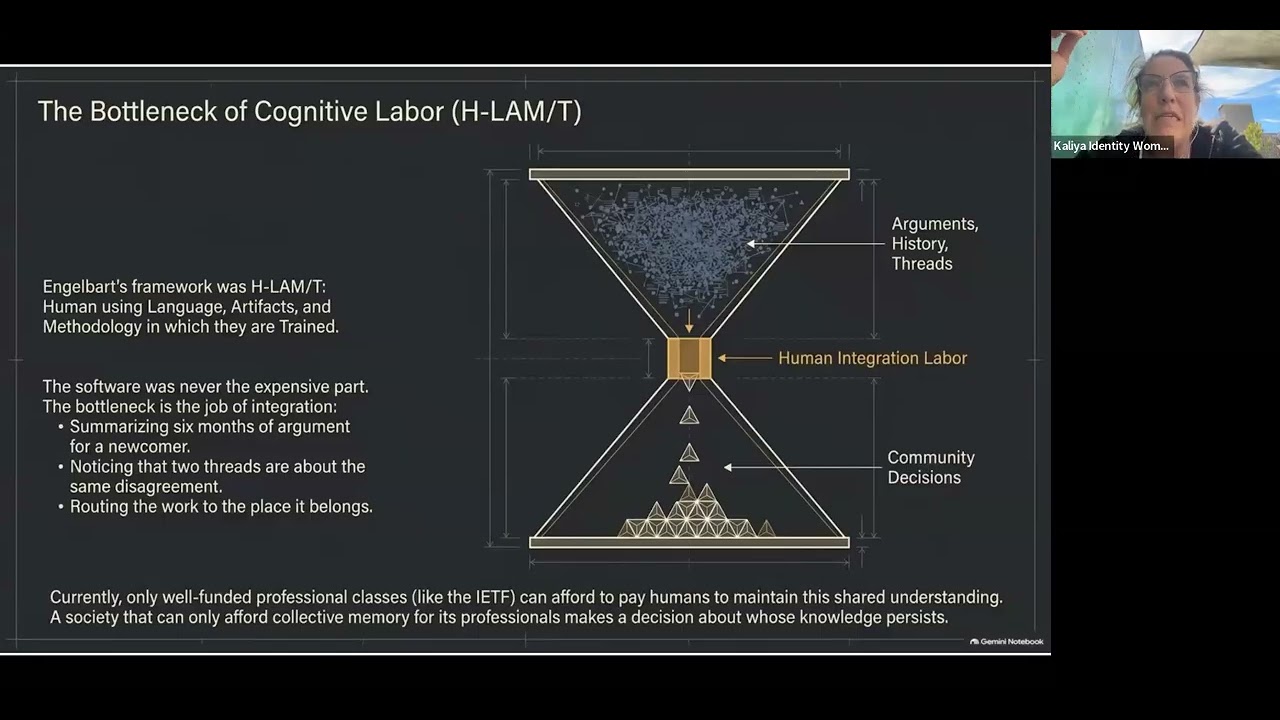
Kaliya Young presents her Protocol Institute-funded research on the IETF as a 'group brain' — a durable collective cognition combining a memory substrate (the data tracker, RFC series, mailing lists) with a human 'knowing' culture (rough consensus, birds-of-a-feather sessions, sortition-based leader selection) that together produce capacities no individual member holds. She extends the framework to Wikipedia and DAOs as comparative cases, introduces the concept of a 'group membrane' (who's in/out and how boundaries harden toward power), and argues AI should augment rather than replace human group cognition, positioning group-level alignment as a missing middle between individual and humanity-wide AI alignment debates.

Related resources

Talk

Inventing Psychohistory: Discussion

Open discussion session following the 'Inventing Psychohistory' symposium talks, with participants including Andre, Florian, Shawn, Venkatesh Rao, Sachin, and Mike Travers debating pace-layer time theory, fashion as an interface layer, and Shawn's concept of 'new nature' as technological systems with no one to appeal to. Venkatesh Rao connects this to Paul Ford's 'why wasn't I consulted' essay and Dan Davies' unaccountability machine thesis, arguing complex systems becoming unaccountable makes them paradoxically more predictable as autonomous machines; Mike Travers questions how this relates to historical disenchantment and Descola's animism framework.

Aneesh Sathe, Andre, Florian, Shawn, Venkatesh Rao, Sachin, Mike Travers

Talk

The Political Economy of Protocols

Trent van Epps (Protocol Guild) presents a four-corner political economy framework for protocols adapted from Lawrence Lessig's 'pathetic dot' theory—norms, market, state, and new nature—arguing that protocols generate far more value than they capture and whoever governs the funding/labor/legitimacy flows shapes the protocol itself. He proposes measurable indicators for each corner (e.g., open-source status, corporate sponsorship share, legal mandates, cryptographic discretion-reduction) and traces trajectories through case studies including the English commons, CHI conference capture, Chromium's market dominance, DNS/ICANN's state transition, Linux's 30-year drift toward center, and Ethereum's tensions around Bitmine's treasury strategy and EF succession.</br>Van Epps introduces concepts like 'capture,' 'tenseity' (borrowed from tensional integrity sculptures), and ossification to describe how competing vectors pull a protocol's governance toward different corners over time, closing with open questions about whether AI and post-quantum transitions will shift Ethereum's position in this political economy.

Trent van Epps

Talk

A Common Protocol for Composable, Modular Organizations

Simone Cicero of Boundaryless presents O2A (Open Organisation Alliance), a proposed open standard for making organizations 'composable' by replacing implicit coordination mechanisms like hierarchy and meetings with an explicit, machine-readable contract graph of units, offerings, and relationships. He argues the protocol's compact grammar—three economic primitives (purchase, revenue split, investment) plus composition mechanisms—can represent bespoke institutional arrangements like Haier's Rendanheyi model or joint ventures as 'sentences' in a common organizational language, becoming essential as AI agents enter firms and transaction costs collapse.

Simone Cicero