Skip to content

The Nature of Trust: Weaving Identity, Relationship, and Place

TalkKaliya Young, Kevin Triplett
The Nature of Trust: Weaving Identity, Relationship, and Place

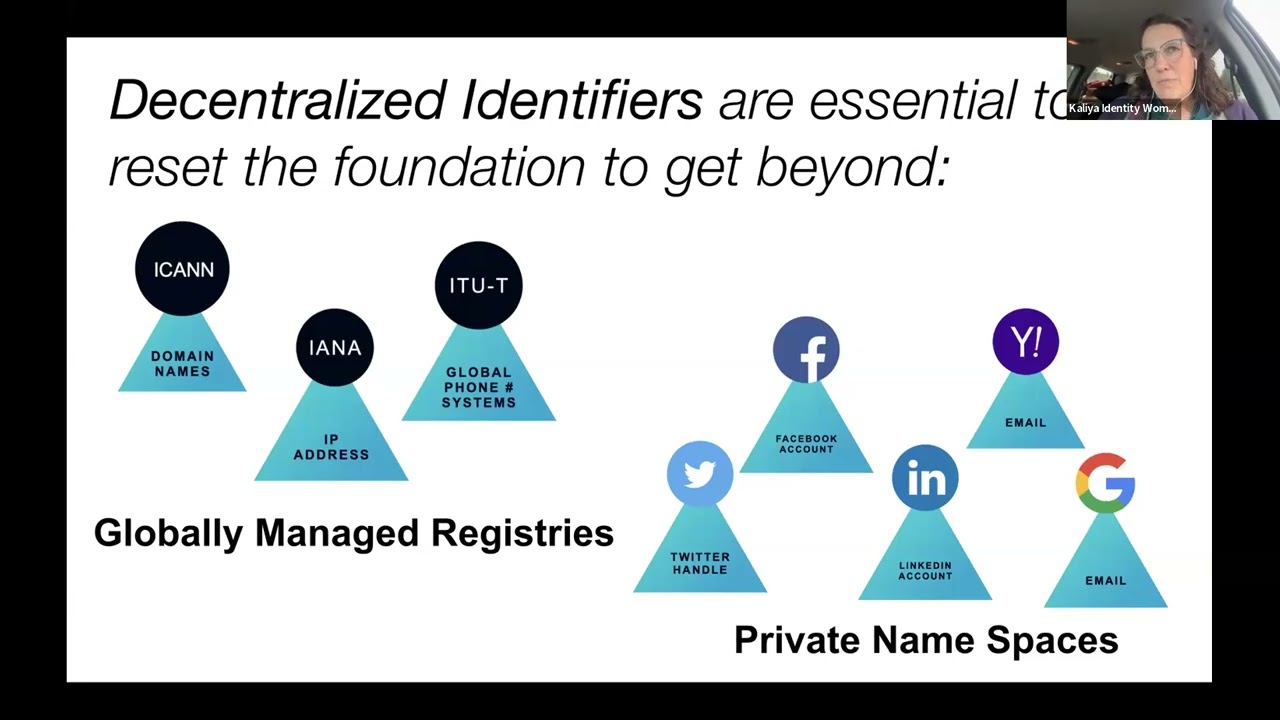
Kaliya Young argues that hard technical protocols (like those governing the Linux kernel) depend on 'soft' relational protocols for trust, using the XZ backdoor incident—where a fabricated contributor nearly inserted malware—as proof that the failure was relational, not cryptographic. She traces digital identity through three generations (username/password, OAuth/OpenID, then DIDs/verifiable credentials) to a proposed third generation of 'digital trust graphs': peer-to-peer verifiable relationship credentials, verifiable membership credentials, and verifiable trust agents, developed through the Trust Over IP/Decentralized Trust Graph working group. Kevin Triplett discusses Project Weave's focus on adoption, emphasizing that groups—not individuals—should be the unit of reputation and AI alignment, and that these protocols can be applied locally, even to place-rooted neighborhood governance.

Related resources

Talk

Open Social Protocols: A Commons-Based Protocol Layer

Jose Leal (with Scott Clearwater) presents Open Social Protocols, a framework built on Needs (recurring coordination conditions) around which communities publish, fork, and adopt Protocols rather than collapsing into single fixed agreements. He describes 'bridging protocols' that let multiple competing protocols for the same need coexist and interoperate, built atop the AT Protocol and a 'Common Ground' layer, citing examples like Morning Star Farms and Buurtzorg as organizations already operating this way without naming it 'protocol'.

Jose Leal, Scott Clearwater

Talk

Governance Axioms

Eric Alston presents a framework of five recurring 'governance axioms' for protocol design—incomplete rules, governance-as-conflict, mechanical concentration of authority, asymmetric incentives from shared resources, and the transparency-privacy tradeoff—arguing these tensions can never be designed away, only managed through mechanisms like killswitches, veto-gates, and tiered amendment rules. Drawing on his experience advising Cardano's constitution, DAOs, and peace processes, Alston contends that 'incomplete rules' mean norms and discretion inevitably fill gaps left by any formally encoded protocol, and that durable systems require 'dynamic fidelity'—credible commitments combined with constrained capacity for adaptation rather than either permanent rigidity or unchecked flux.

Eric Alston

Talk

De-Dramatizing the Digital: How AI Descends Into New Nature

Sean Stevenson argues that AI is undergoing a 'descent' through Stewart Brand's pace layers—moving from fast fashion/commerce layers down through governance and culture toward nature itself—becoming less dramatic and less contestable as it sinks, following a pattern he traces via Clayton Christensen's theory of attractive profits migrating to the least-optimized layer of a value chain. He proposes a four-stage model (integrate, coordinate, embed, inherit) for this descent and introduces 'appeal foreclosure' versus 'ossification' as a way to distinguish genuine new nature from captured systems, while drawing on Spinoza's natura naturans/naturata and Philippe Descola's ontological framework (naturalism, animism, totemism, analogism) to speculate how AI-plus-protocols might shift human categories of inner life and matter.

Sean Stevenson