Skip to content

Plenary Talk - 2024 Protocol Symposium

TalkTim Beiko, Venkatesh Rao
Plenary Talk - 2024 Protocol Symposium

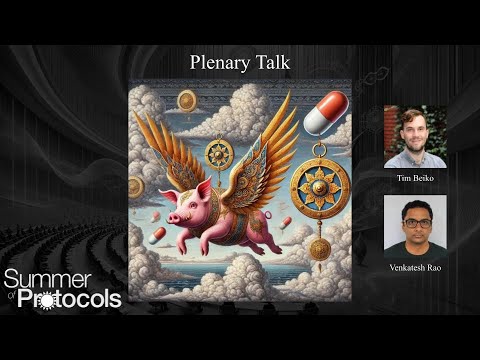
Tim Beiko and Venkatesh Rao open the 2024 Protocol Symposium by recapping Summer of Protocols' two-year evolution, from testing whether 'protocols' form a coherent cross-domain field to this year's focus on applied stewardship, tensions (tradeoff plus conflict), and workshops like the Singapore and Edge Esmeralda pop-ups. Venkatesh then presents three orienting frameworks for the Symposium—the 'technological Tangled Bank,' the 'Erdos-Whitehead protocol age,' and the 'kit space of civilization'—arguing protocols are best understood as a literacy for seeing technology's relation to humans and environment rather than a technology class itself.

Related resources

Talk

Salon II: ARC Regenerative Communities - 2024 Protocol Symposium

Kaliya Young and 'day' present research into the Internet Engineering Task Force (IETF) as a case study in regenerative governance, tracing its origins from the 1969 ARPANET through the 1992 governance crisis that shifted power from Vint Cerf's 'kitchen cabinet' IAB to open working groups organized around 'rough consensus and running code.' They map IETF practices—nomcom's randomized leadership selection, open RFC documentation, dispatch meetings, and ritualized in-person gatherings—onto three pattern languages (Group Works, Wise Democracy, and Social Permaculture) to argue that openness, transparency, and voluntariness are structural necessities, not limitations, for sustaining a healthy digital commons.

Kaliya Young, day

Talk

A Common Protocol for Composable, Modular Organizations

Simone Cicero of Boundaryless presents O2A (Open Organisation Alliance), a proposed open standard for making organizations 'composable' by replacing implicit coordination mechanisms like hierarchy and meetings with an explicit, machine-readable contract graph of units, offerings, and relationships. He argues the protocol's compact grammar—three economic primitives (purchase, revenue split, investment) plus composition mechanisms—can represent bespoke institutional arrangements like Haier's Rendanheyi model or joint ventures as 'sentences' in a common organizational language, becoming essential as AI agents enter firms and transaction costs collapse.

Simone Cicero

Talk

Group Brains: Minds Made of People

Kaliya Young presents her Protocol Institute-funded research on the IETF as a 'group brain' — a durable collective cognition combining a memory substrate (the data tracker, RFC series, mailing lists) with a human 'knowing' culture (rough consensus, birds-of-a-feather sessions, sortition-based leader selection) that together produce capacities no individual member holds. She extends the framework to Wikipedia and DAOs as comparative cases, introduces the concept of a 'group membrane' (who's in/out and how boundaries harden toward power), and argues AI should augment rather than replace human group cognition, positioning group-level alignment as a missing middle between individual and humanity-wide AI alignment debates.

Kaliya Young