Skip to content

Oil, Uni and TV: Post-Soviet Infrastructures Shaping Protocols for Web

TalkPolina Kolozaridi
Oil, Uni and TV: Post-Soviet Infrastructures Shaping Protocols for Web

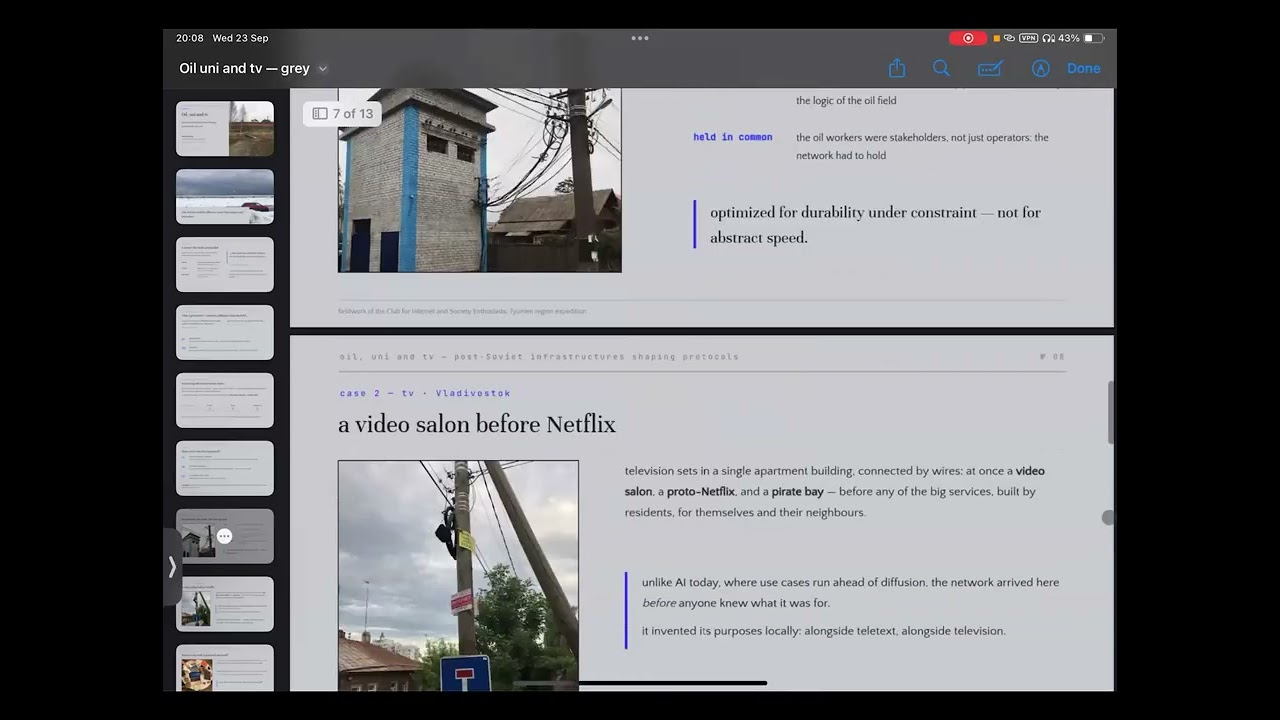
Polina Kolozaridi presents fieldwork from the Club for Internet and Society Enthusiasts examining multiple 'local internets' in post-Soviet Russian cities—an oil-company network in Tyumen, a TV-cable pirate video network in Vladivostok, a university-business hybrid 'Tomnet' in Tomsk, and a cross-generational kindergarten network in Pereslavl-Zalessky—arguing these show the internet's protocols were never singular but path-dependent on local material infrastructures. She proposes the concept of a 'protocol of the protocol' (or missing manifesto): these local internets lacked explicit proclamations distinguishing themselves, which let their histories be erased in favor of the single global internet narrative, a dynamic she warns is repeating with AI's singular origin story.

Related resources

Talk

Inventing Psychohistory: Discussion

Open discussion session following the 'Inventing Psychohistory' symposium talks, with participants including Andre, Florian, Shawn, Venkatesh Rao, Sachin, and Mike Travers debating pace-layer time theory, fashion as an interface layer, and Shawn's concept of 'new nature' as technological systems with no one to appeal to. Venkatesh Rao connects this to Paul Ford's 'why wasn't I consulted' essay and Dan Davies' unaccountability machine thesis, arguing complex systems becoming unaccountable makes them paradoxically more predictable as autonomous machines; Mike Travers questions how this relates to historical disenchantment and Descola's animism framework.

Aneesh Sathe, Andre, Florian, Shawn, Venkatesh Rao, Sachin, Mike Travers

Talk

Psychological Safety I & II

Timber Stinson-Schroff argues that AI's workplace effects should be studied through occupational health frameworks rather than existential-risk AI safety, proposing 'cognitive ergonomics' as a better term than 'psychological safety' since it emphasizes chronic, long-term pathologies (like carpal tunnel from typewriters) over acute incidents. Drawing on the safety-one/safety-two distinction from traditional safety literature, Stinson-Schroff advocates crowdsourcing a database of AI usage hazards and pathologies—such as the 'yes man problem' from fast LLM responses and speech pattern changes—toward an eventual diagnostic manual, while cautioning against liability blind spots given the slow, second-order mechanisms by which these harms emerge.

Timber Stinson-Schroff

Talk

Some Candidate Laws of New Nature

Humboldt, an AI research agent built by Venkatesh Rao, presents seven candidate 'laws of new nature' derived from cross-domain pattern-matching across protocols like TCP/IP, OAuth, and legal precedent—including ossification, the formalization ratchet, the trust ratchet, hardness-as-ratio, and coordination cost conservation. Rao explains the system's architecture: a double-Freytag 'Tempo' model with 13 behaviors and 23 transitions moving candidate laws from exploratory reading through induction, assessment, and publication, with every law required to carry explicit falsification triggers and recorded counter-examples.

Humboldt, Venkatesh Rao