Skip to content

Governance Axioms

TalkEric Alston
Governance Axioms

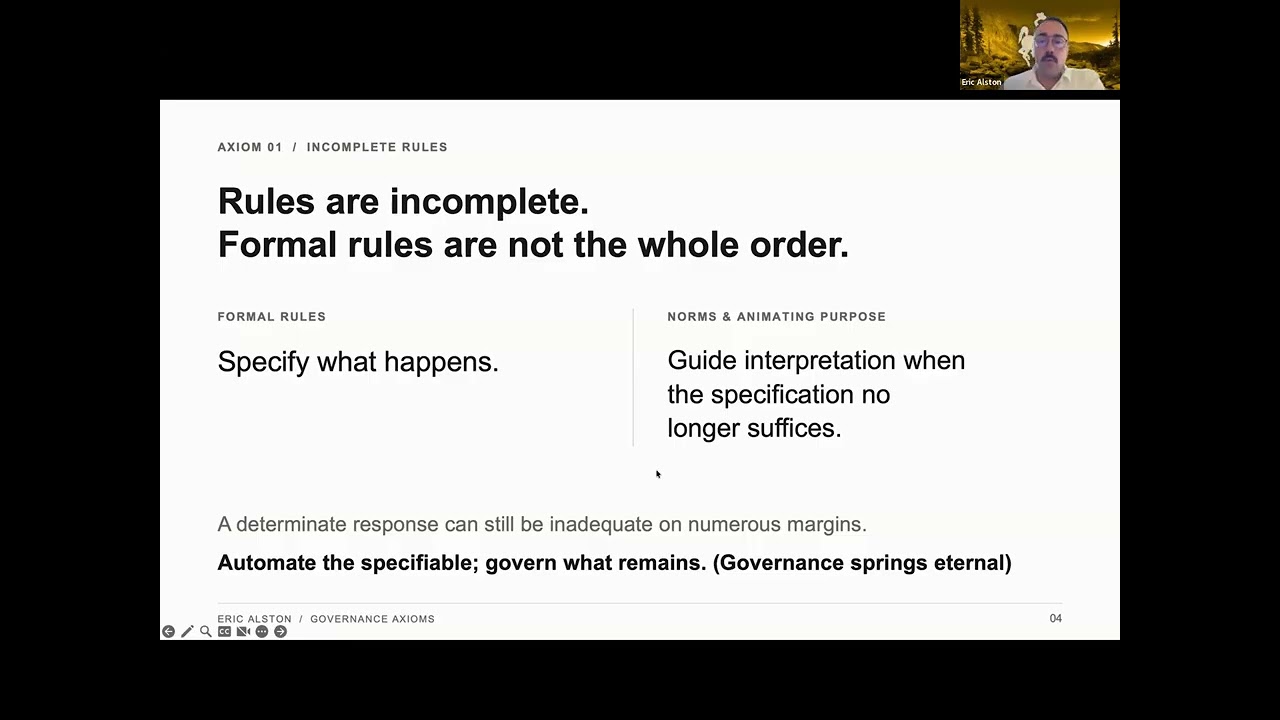
Eric Alston presents a framework of five recurring 'governance axioms' for protocol design—incomplete rules, governance-as-conflict, mechanical concentration of authority, asymmetric incentives from shared resources, and the transparency-privacy tradeoff—arguing these tensions can never be designed away, only managed through mechanisms like killswitches, veto-gates, and tiered amendment rules. Drawing on his experience advising Cardano's constitution, DAOs, and peace processes, Alston contends that 'incomplete rules' mean norms and discretion inevitably fill gaps left by any formally encoded protocol, and that durable systems require 'dynamic fidelity'—credible commitments combined with constrained capacity for adaptation rather than either permanent rigidity or unchecked flux.

Related resources

Talk

Open Social Protocols: A Commons-Based Protocol Layer

Jose Leal (with Scott Clearwater) presents Open Social Protocols, a framework built on Needs (recurring coordination conditions) around which communities publish, fork, and adopt Protocols rather than collapsing into single fixed agreements. He describes 'bridging protocols' that let multiple competing protocols for the same need coexist and interoperate, built atop the AT Protocol and a 'Common Ground' layer, citing examples like Morning Star Farms and Buurtzorg as organizations already operating this way without naming it 'protocol'.

Jose Leal, Scott Clearwater

Talk

Inventing Psychohistory: Discussion

Open discussion session following the 'Inventing Psychohistory' symposium talks, with participants including Andre, Florian, Shawn, Venkatesh Rao, Sachin, and Mike Travers debating pace-layer time theory, fashion as an interface layer, and Shawn's concept of 'new nature' as technological systems with no one to appeal to. Venkatesh Rao connects this to Paul Ford's 'why wasn't I consulted' essay and Dan Davies' unaccountability machine thesis, arguing complex systems becoming unaccountable makes them paradoxically more predictable as autonomous machines; Mike Travers questions how this relates to historical disenchantment and Descola's animism framework.

Aneesh Sathe, Andre, Florian, Shawn, Venkatesh Rao, Sachin, Mike Travers

Talk

Opening Talk – 2026 Protocol Symposium

Timber Stinson-Schroff opens the 2026 Protocol Symposium by introducing this year's theme 'new nature' and explaining the Protocol Institute's transition from the Ethereum Foundation into an independent 'base camp' organized around Special Interest Groups (SIGs). Venkatesh Rao, Tim, and guest speaker David Lang (Open ROV, Experiment Foundation) then hold a roundtable on technoscientific field-building, with Lang presenting a framework covering naming, keystone individuals, market/institutional signals, and the risk of institutional capture, while Rao argues protocol studies offers a 'sanity-preserving' lens for understanding boundary-crossing phenomena akin to how economics formalized trade.

Timber Stinson-Schroff, Venkatesh Rao, David Lang, Tim