Skip to content

Archival Time as a New Natural Resource

TalkSachin Benny
Archival Time as a New Natural Resource

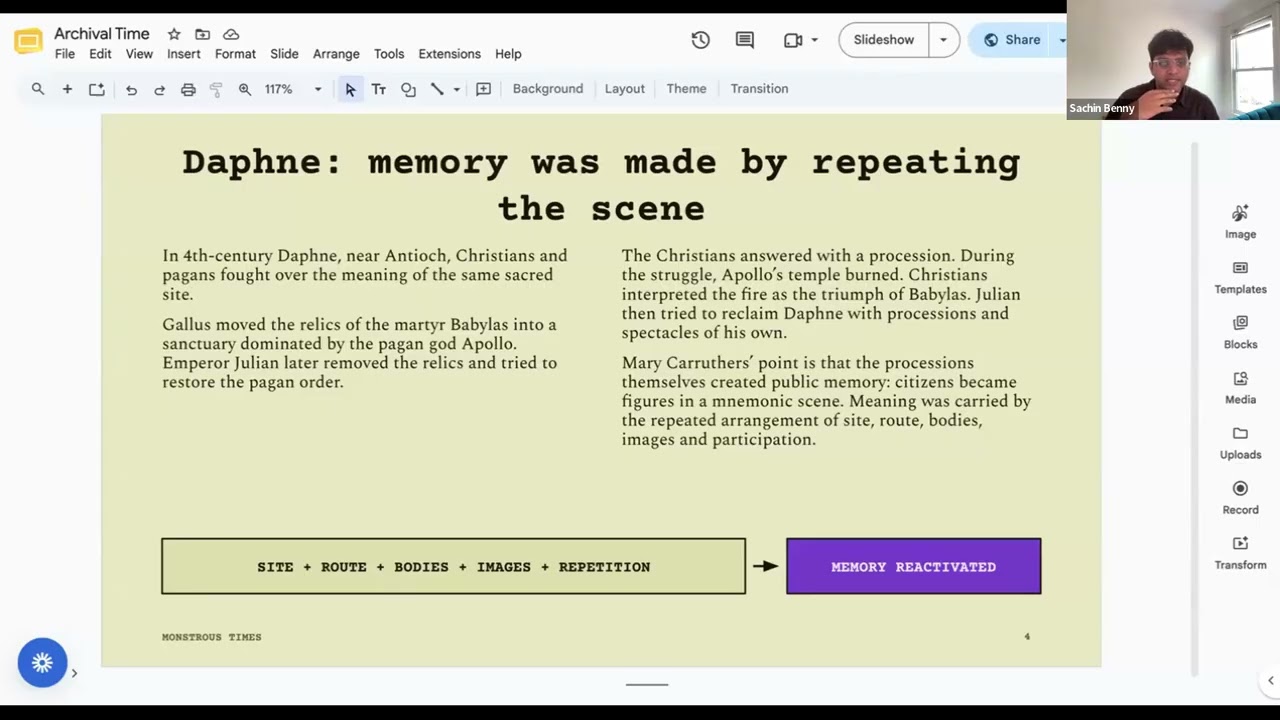
Sachin Benny argues that AI modernity is reorganizing our relationship to the past the way industrial capitalism reorganized our relationship to the future, coining 'Archival Time' as a condition where traces of prior events become retrievable without recreating the event. He contrasts this with Bakhtin's 'Carnival Time,' bounded periods where accumulated traces lose authority and things get unmade and remade, drawing on William Sewell's eventfulness framework (path dependency, temporal heterogeneity, contingency) to argue eventful history requires a mix of both archival inheritance and carnivalesque rupture.

Related resources

Talk

Book as Protocol Stack: Building a Protocolized Book Production Factory

Jenna Dixon presents an in-progress 'book-production factory' that reframes book publishing as a protocol stack: a structured transmittal handshake between author and factory, styles treated as controlled vocabulary separating meaning from appearance, a conformance-checking preflight step, and a deterministic pipeline yielding multiple faithful output formats (.epub, print PDF) from one source. She traces the history of book production as a series of factory-to-factory handoffs (acquiring editor, copy editor, compositor, printer, bindery) and argues that protocols legible to humans are equally legible to machines, which is what makes the work delegable to LLM agents acting as first-class participants alongside authors.

Jenna Dixon

Talk

Ethereum: A Microcosm for Protocol Studies

Tim Beiko, core coordinator of Ethereum protocol development, traces how his own need for frameworks to steward Ethereum led to the founding of Summer of Protocols and now the Protocol Institute. He argues Ethereum functions as a 'model organism' for protocol studies—citing the 2017 Parity multisig freeze, Uniswap's constant-product market design and fee-governance debates, prediction markets' oracle problems, and atomic flash loans—to illustrate his concept of protocols as 'engineered arguments' that draw a boundary between formal rules and human judgment.

Tim Beiko

Talk

Oil, Uni and TV: Post-Soviet Infrastructures Shaping Protocols for Web

Polina Kolozaridi presents fieldwork from the Club for Internet and Society Enthusiasts examining multiple 'local internets' in post-Soviet Russian cities—an oil-company network in Tyumen, a TV-cable pirate video network in Vladivostok, a university-business hybrid 'Tomnet' in Tomsk, and a cross-generational kindergarten network in Pereslavl-Zalessky—arguing these show the internet's protocols were never singular but path-dependent on local material infrastructures. She proposes the concept of a 'protocol of the protocol' (or missing manifesto): these local internets lacked explicit proclamations distinguishing themselves, which let their histories be erased in favor of the single global internet narrative, a dynamic she warns is repeating with AI's singular origin story.

Polina Kolozaridi