Skip to content

Seapunk: World Protocolizations On Reverse Imagineering as Method

TalkSamuel Chua
Seapunk: World Protocolizations On Reverse Imagineering as Method

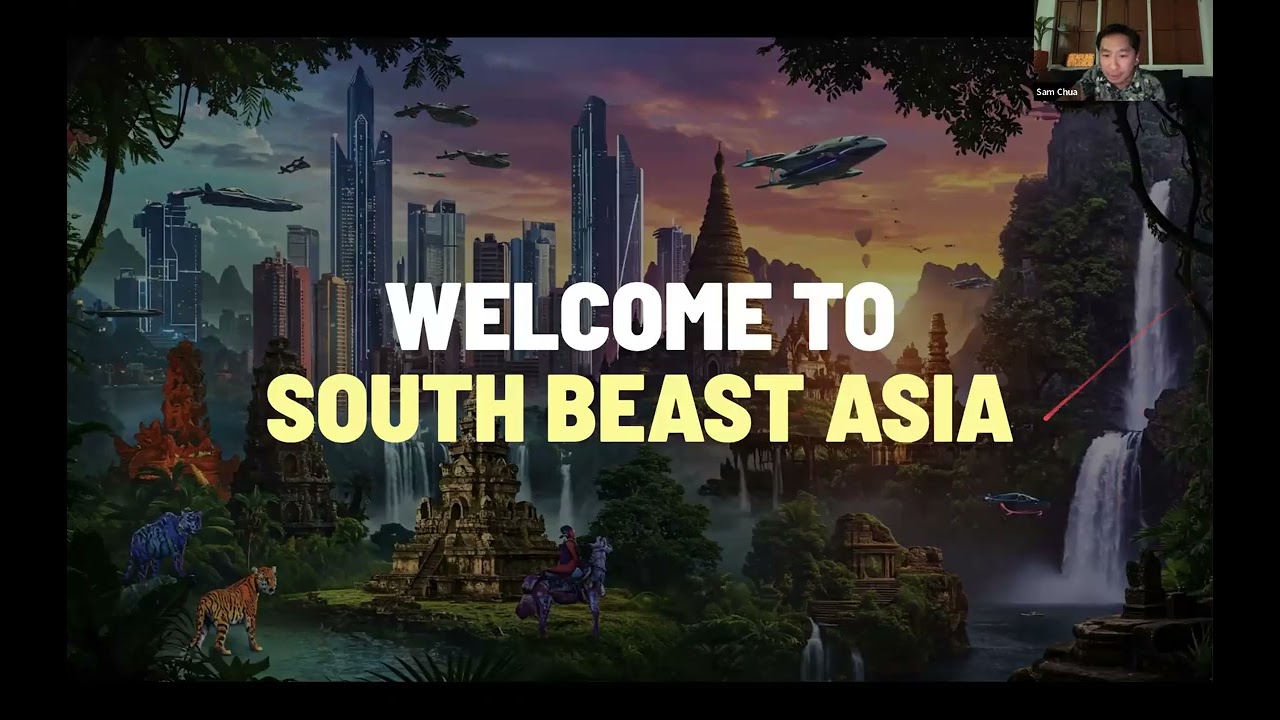
Samuel Chua of Seapunk Studios presents 'reverse-imagineering,' a methodology for protocol studies that starts from speculative fiction worlds and works backward to infer the protocols that would need to exist to make them plausible. He illustrates this through three Seapunk worlds—South(east Asia) with neoanimist distributed AI and 'ghost machine' commons-hardening, SNOW Society's shanzhai-inspired peer-to-peer climate adaptation supply chains, and the 67th World's longevity/automation governance where immortality requires earning social legitimacy—arguing that building fiction first surfaces protocol ideas that direct present-to-future design work would miss.

Related resources

Talk

Divergent Protocols: A Speculative Protocol for Cultural Convergence Zones

Nicolás Madoery presents 'divergent protocols' as a counter-model to standard protocols that converge toward homogenization, arguing that AI and robotics now function as infrastructure (not tools) through which culture becomes 'liquid' and infinitely re-versioned. Drawing on examples like AI-generated Argentine folklore, a dancing folk robot, and his PIACH framework for cultural organizations, he proposes protocols that preserve diversity by naming what is lost, keeping source names, and leaving room for noise rather than optimizing transmission.

Nicolás Madoery

Talk

Don't Cross the Lines: Mazes as Minimal Protocols

Daniel Schmidt argues that mazes are a minimal formal instantiation of protocols, not just a metaphor, using his own maze-drawing history and games to illustrate concepts like hard vs. soft protocols (physical walls vs. crossable paper lines), scale-entangled vs. scale-lined navigation, and stigmergic memory. He demonstrates an ant colony pheromone simulation, a multiplayer infinite maze with shareable 'pebble' markers, a maze-design platform separating protocol-author from protocol-navigator with heatmaps of friction points, and an art-gallery maze as medium. Venkatesh Rao joins to explain his 'clockless clock' maze, a topological map of thought-space (rat/goat/crow vertices) designed by Schmidt to represent arrested development and spiraling toward nirvana.

Daniel Schmidt, Venkatesh Rao

Article

Haikus to Fly By

Terminal Aerodrome Forecasts (TAFs) are cryptic, haiku-like weather predictions produced continuously by meteorologists worldwide that directly inform pilot decisions and shape aviation operations at every scale. These terse textual protocols encode atmospheric phenomena and thresholds that determine individual actions, airport procedures, and global traffic patterns.

Matthew McDowell-Sweet