Skip to content

Fireside Chat with Nadia Asparouhova

TalkNadia Asparouhova
Fireside Chat with Nadia Asparouhova

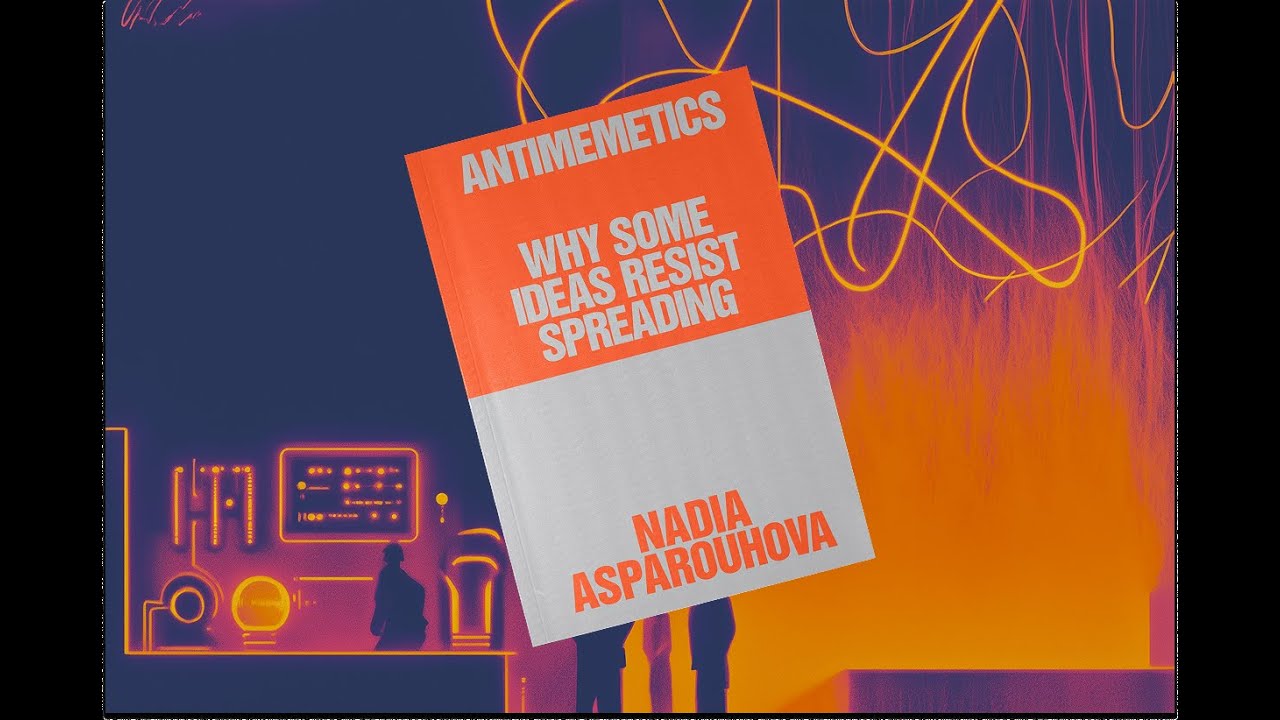
In this fireside chat, Nadia Asparouhova discusses the concept of anti-memes—ideas that resist spreading or being remembered—drawing on SCP fiction and her book Anti-Mimetic. She extends an epidemiological analogy to online communities, critiquing Venkatesh Rao's 'cozy web' concept by comparing group chats to poorly-ventilated COVID pods that compress and mutate ideas rather than truly insulating people from them, and connects her SOP23 essay's 'Whitehead protocol' (good, attention-freeing automation) versus 'Kafka protocol' (bad, confusion-inducing bureaucracy) to how attention and memory shape which ideas survive.

Related resources

Talk

Archival Time as a New Natural Resource

Sachin Benny argues that AI modernity is reorganizing our relationship to the past the way industrial capitalism reorganized our relationship to the future, coining 'Archival Time' as a condition where traces of prior events become retrievable without recreating the event. He contrasts this with Bakhtin's 'Carnival Time,' bounded periods where accumulated traces lose authority and things get unmade and remade, drawing on William Sewell's eventfulness framework (path dependency, temporal heterogeneity, contingency) to argue eventful history requires a mix of both archival inheritance and carnivalesque rupture.

Sachin Benny

Article

Reflections From Memoria

Kei Kreutler reports from Memoria, an unconference on spaced repetition and memory systems organized by Saul Munn and Raj Thimmiah. The Memory Research Group is launching a new module on digital memory architectures, examining memory management in AI, computational memory history, and how digital technologies reshape human remembrance.

Kei Kreutler

Talk

Cosmopolis, Metropolis, Nation-State: 3 Protocols for Articulating Civilizational Memory

Venkatesh Rao presents a research talk introducing 'cosmopolis' as a third geographic logic—alongside territorial (nation-state) and nodal (metropolis) logics—defined as a geography shaped by a way of life induced by major technology, arguing that cosmopolitical/behavioral logic is where civilizational memory is most robustly carried since territories and cities 'can forget' but cosmopolises 'truly remember.' He builds a framework of soil/stack/virtual-soil embodiments and effective/declarative/procedural memory types, applying it to historical cases (print culture, Islamic world, chivalry) and emerging computational cosmopolises (blockchain, AI, IoT, VR) to argue that behavioral-logic-driven 'protocols of circulation' offer a livable alternative to monolithic centralized or oozifying nodal futures.

Venkatesh Rao