Skip to content

The Role of Identity in Decentralized Dispute Resolution Protocols

TalkWilliam George
The Role of Identity in Decentralized Dispute Resolution Protocols

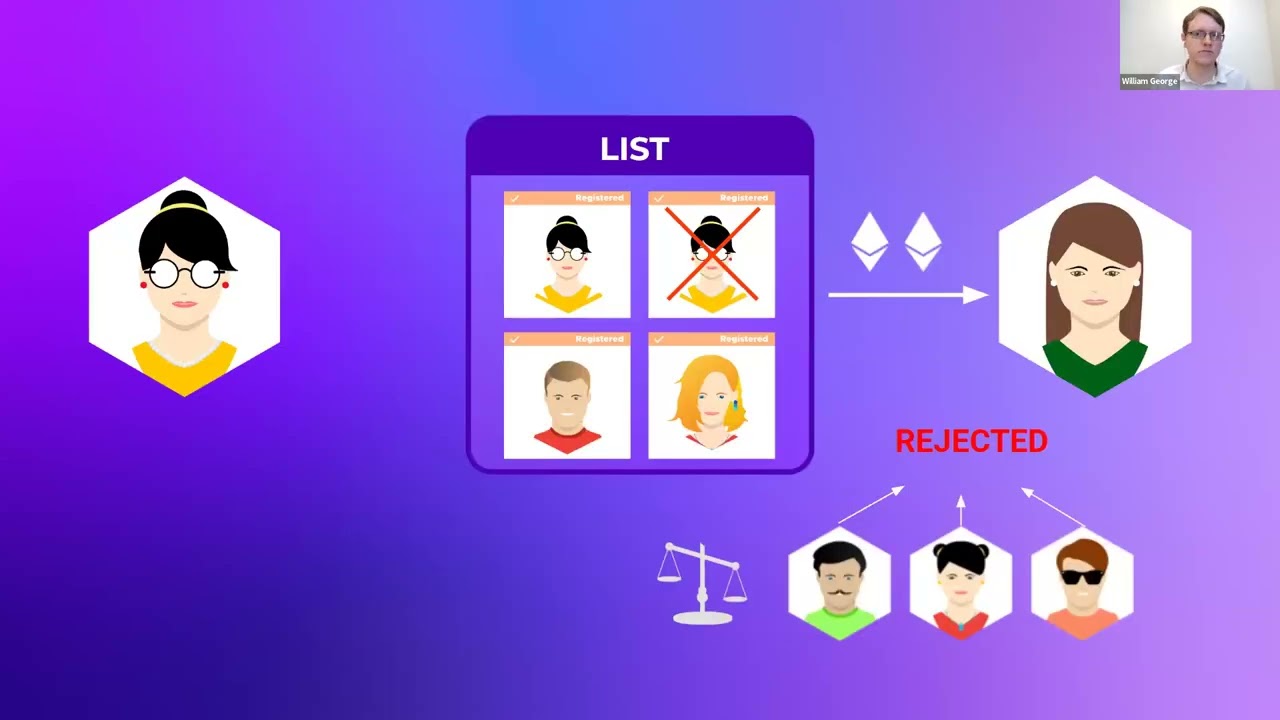
William George, a mathematician working on mechanism design for the Kleros decentralized dispute resolution protocol, explains how the absence of robust identity tools historically forced protocols like Kleros v1 into purely token-weighted, financialized juror-selection mechanisms vulnerable to Sybil attacks via address splitting. He shows how combining imperfect proof-of-personhood systems (like Proof of Humanity) with financial staking creates a 'Swiss cheese' security model where both layers must be broken simultaneously, and extends this to soulbound tokens (from Weyl/Ohlhaver/Buterin) for credential-filtered, diversity-weighted juror panels inspired by quadratic funding. In Q&A, Venkatesh Rao pushes back that such mechanisms impose an esoteric 'homo economicus' framing that clashes with how real communities handle trust and cheater-detection socially.

Related resources

Talk

A Common Protocol for Composable, Modular Organizations

Simone Cicero of Boundaryless presents O2A (Open Organisation Alliance), a proposed open standard for making organizations 'composable' by replacing implicit coordination mechanisms like hierarchy and meetings with an explicit, machine-readable contract graph of units, offerings, and relationships. He argues the protocol's compact grammar—three economic primitives (purchase, revenue split, investment) plus composition mechanisms—can represent bespoke institutional arrangements like Haier's Rendanheyi model or joint ventures as 'sentences' in a common organizational language, becoming essential as AI agents enter firms and transaction costs collapse.

Simone Cicero

Talk

Markets and the Journey to Neutrality

Nicholas Fett traces the history of market neutrality from 1889 Oklahoma land runs and Adam Smith's moral sentiments through Keynes, the Mont Pelerin Society, and into crypto, arguing that protocols designed to be neutral (Bitcoin's decentralization, Ethereum's 'crops' ethos) inevitably get captured by economic incentives like mining and block-builder centralization. He uses the 'tunnel' and 'one more lane' analogies to argue that building for neutral principles without a defined societal goal leads to outcomes divorced from original intentions, and that protocol designers must instead encode explicit purpose rather than chase an unattainable neutral equilibrium.

Nicholas Fett

Talk

Proliferation of Intelligence: Business and Hyper Learning Machines

Krishnakumar Gurumurthy argues that AI's frontier capabilities are outpacing business models built on human labor, creating a socio-economic gap disguised as a technical one. He proposes discretizing business processes into indivisible functional units, mapping them to appropriate AI techniques (neural operators, transformers, RL, etc.), and building a new enterprise stack with guardrails and trust architecture—drawing an extended analogy to how electricity safety standards (insulation, circuit breakers, licensed electricians) evolved to argue for similar AI containment, validation, and certification regimes.

Krishnakumar Gurumurthy