Skip to content

Hand Washing and Bitcoin Share a Skeleton

TalkShingai Thornton
Hand Washing and Bitcoin Share a Skeleton

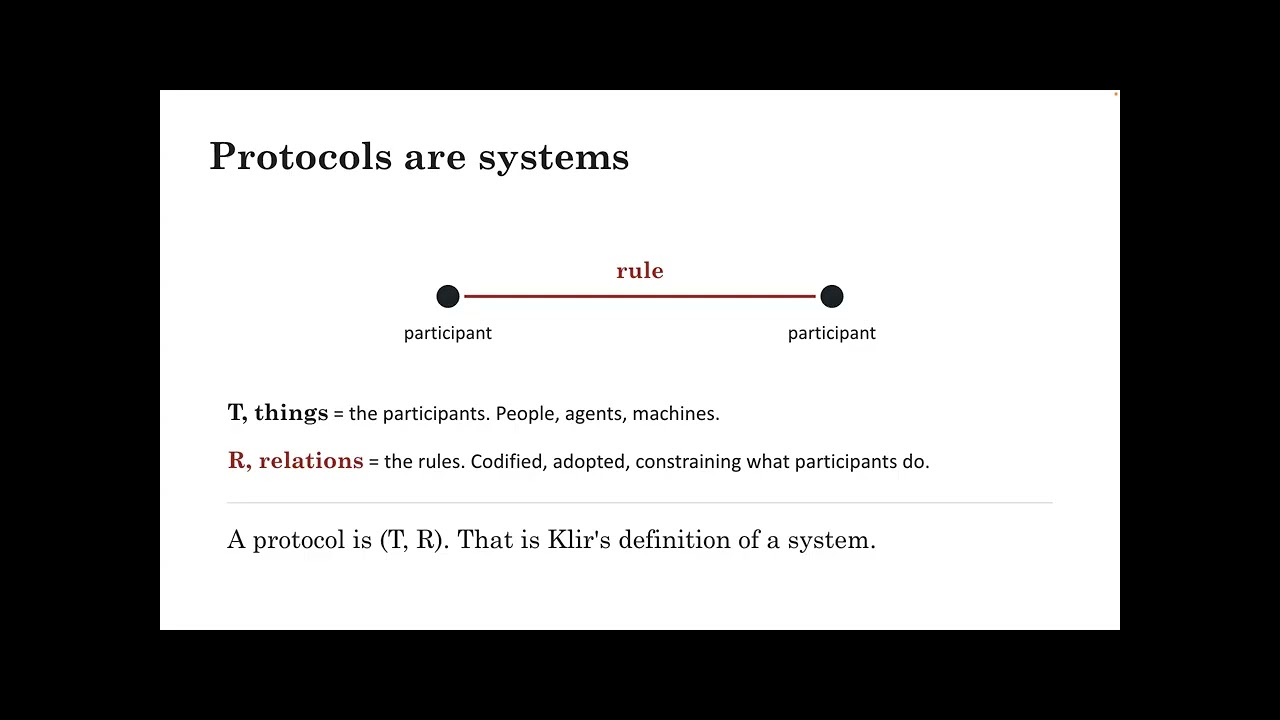
Shingai Thornton argues that protocols are formally systems, proving that seven independent systems-theory traditions (Klir, Bunge, Mobus, etc.) share one irreducible structure—a 'walking arrow' or quiver where one thing depends on another. She uses Lean 4 to machine-verify this convergence across three worked examples: handwashing (a contamination-threshold homeostat), TCP/HTTP composition, and Bitcoin's difficulty adjustment (a fixed-point-governed homeostat), proposing this as a candidate 'floor' for a grand unified protocol modeling theory.

Related resources

Talk

Protocols for Co-Cognition: The New Nature of Collaboration in the AI Era

Robert Peake presents empirical findings from his AI Co-Working Effectiveness Survey, which maps respondents onto a Sovereignty-versus-Trust grid yielding four postures (Partnership, Hypervigilance, Overreliance, Compliance) and measures cognitive load, debt, dissonance, and sovereignty. He argues that adoption level does not predict cognitive cost—posture does—and proposes explicit protocols like a 'DRIVE' loop (Decide, Request, Iterate, Validate, Evolve) and externalized tooling (e.g., knowledge-promotion taxonomies, forced session-closing rituals) to convert fragile human vigilance into durable, low-cost guardrails against AI-induced deskilling.

Robert Peake

Talk

Psychological Safety I & II

Timber Stinson-Schroff argues that AI's workplace effects should be studied through occupational health frameworks rather than existential-risk AI safety, proposing 'cognitive ergonomics' as a better term than 'psychological safety' since it emphasizes chronic, long-term pathologies (like carpal tunnel from typewriters) over acute incidents. Drawing on the safety-one/safety-two distinction from traditional safety literature, Stinson-Schroff advocates crowdsourcing a database of AI usage hazards and pathologies—such as the 'yes man problem' from fast LLM responses and speech pattern changes—toward an eventual diagnostic manual, while cautioning against liability blind spots given the slow, second-order mechanisms by which these harms emerge.

Timber Stinson-Schroff

Talk

Some Candidate Laws of New Nature

Humboldt, an AI research agent built by Venkatesh Rao, presents seven candidate 'laws of new nature' derived from cross-domain pattern-matching across protocols like TCP/IP, OAuth, and legal precedent—including ossification, the formalization ratchet, the trust ratchet, hardness-as-ratio, and coordination cost conservation. Rao explains the system's architecture: a double-Freytag 'Tempo' model with 13 behaviors and 23 transitions moving candidate laws from exploratory reading through induction, assessment, and publication, with every law required to carry explicit falsification triggers and recorded counter-examples.

Humboldt, Venkatesh Rao