Skip to content

Ethereum: A Microcosm for Protocol Studies

TalkTim Beiko
Ethereum: A Microcosm for Protocol Studies

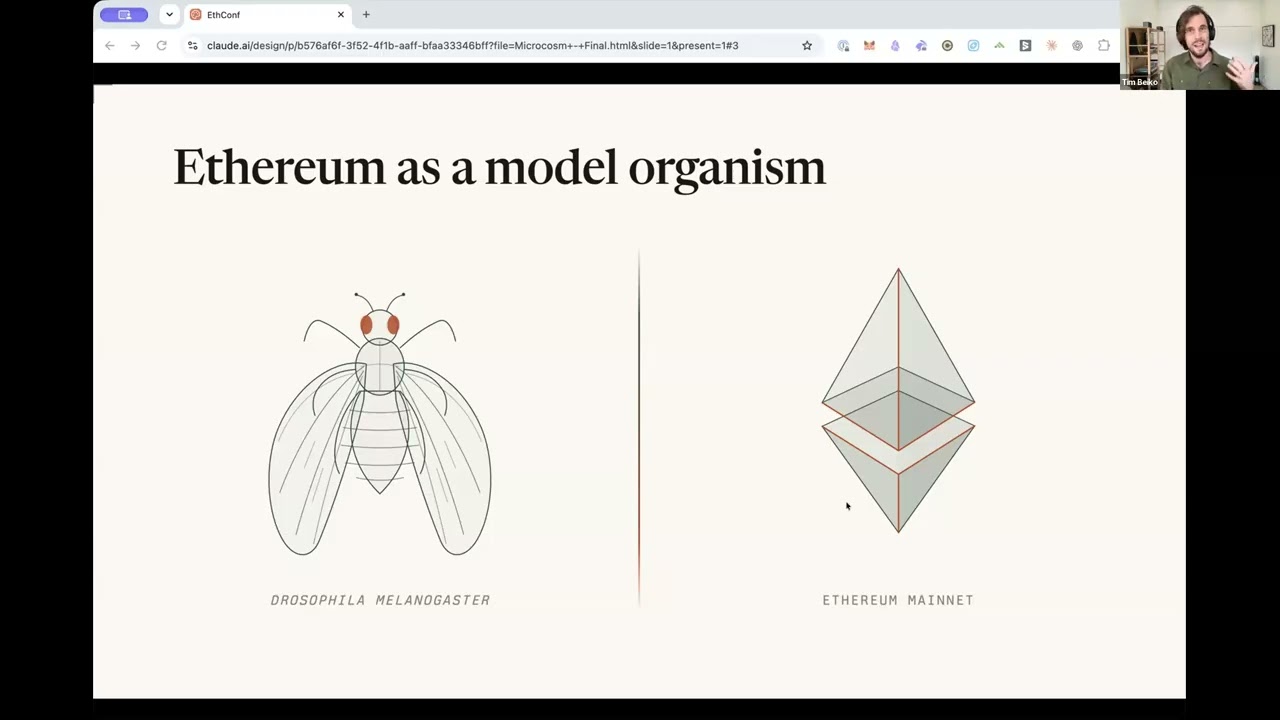
Tim Beiko, core coordinator of Ethereum protocol development, traces how his own need for frameworks to steward Ethereum led to the founding of Summer of Protocols and now the Protocol Institute. He argues Ethereum functions as a 'model organism' for protocol studies—citing the 2017 Parity multisig freeze, Uniswap's constant-product market design and fee-governance debates, prediction markets' oracle problems, and atomic flash loans—to illustrate his concept of protocols as 'engineered arguments' that draw a boundary between formal rules and human judgment.

Related resources

Talk

The Indelible Importance of Illegibility

Patrick Atwater, innovation program manager at the Metropolitan Water District of Southern California, argues that protocols exist simultaneously as documented formalisms and undocumented implicit norms, using case studies from a neighborhood park, bridge/infrastructure permitting, and track-2 diplomacy to illustrate this gap. He proposes practical strategies for navigating illegible terrain—black-boxing unknowns, cultivating domain-expert practitioners as guides, and lightweight fieldwork logging (e.g., a 'protocol watching' Notion database)—and shares a real example of a water utility valve project where jurisdictional coordination revealed pseudo-official knowledge and unwritten norms.

Patrick Atwater

Talk

Archival Time as a New Natural Resource

Sachin Benny argues that AI modernity is reorganizing our relationship to the past the way industrial capitalism reorganized our relationship to the future, coining 'Archival Time' as a condition where traces of prior events become retrievable without recreating the event. He contrasts this with Bakhtin's 'Carnival Time,' bounded periods where accumulated traces lose authority and things get unmade and remade, drawing on William Sewell's eventfulness framework (path dependency, temporal heterogeneity, contingency) to argue eventful history requires a mix of both archival inheritance and carnivalesque rupture.

Sachin Benny

Talk

Governance Axioms

Eric Alston presents a framework of five recurring 'governance axioms' for protocol design—incomplete rules, governance-as-conflict, mechanical concentration of authority, asymmetric incentives from shared resources, and the transparency-privacy tradeoff—arguing these tensions can never be designed away, only managed through mechanisms like killswitches, veto-gates, and tiered amendment rules. Drawing on his experience advising Cardano's constitution, DAOs, and peace processes, Alston contends that 'incomplete rules' mean norms and discretion inevitably fill gaps left by any formally encoded protocol, and that durable systems require 'dynamic fidelity'—credible commitments combined with constrained capacity for adaptation rather than either permanent rigidity or unchecked flux.

Eric Alston