Skip to content

Designing Digital Worlds Communities, Protocols, AI, and Power - Andrés Monroy Hernández

LectureAndrés Monroy-Hernández
Designing Digital Worlds Communities, Protocols, AI, and Power - Andrés Monroy Hernández

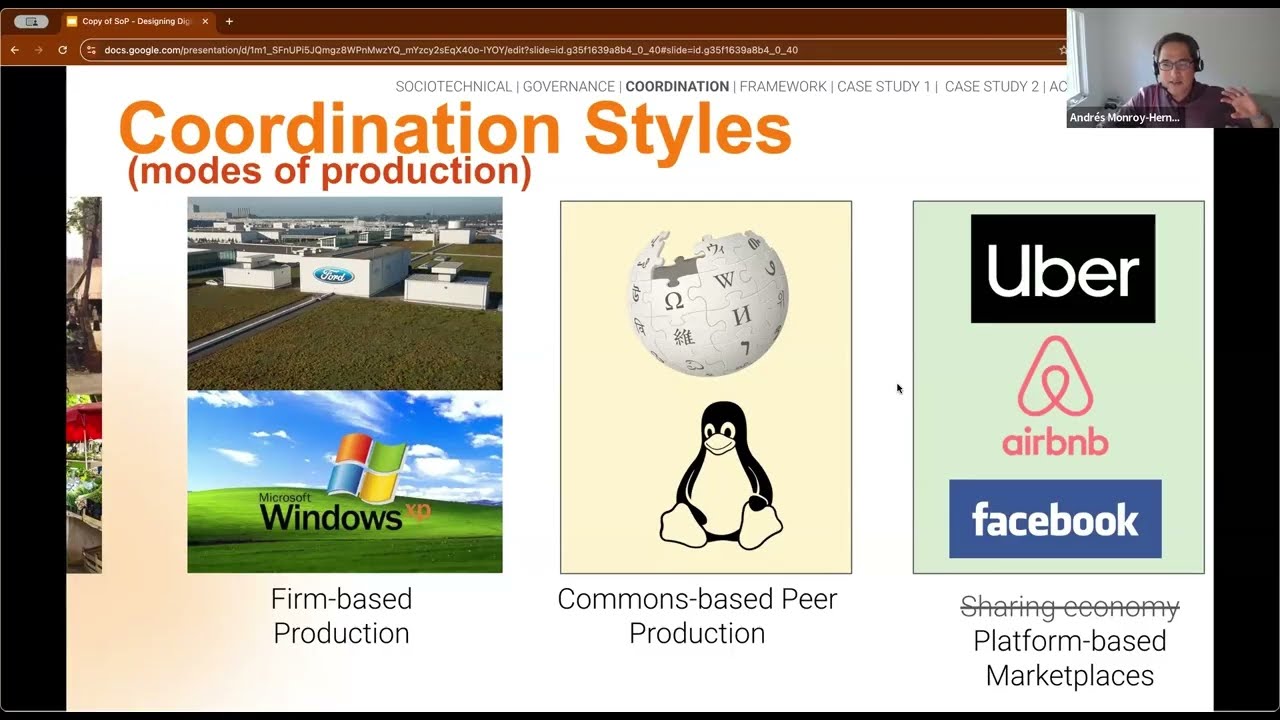
Andrés Monroy-Hernández and Soyeon (So-young) outline a Princeton course on 'designing digital worlds,' tracing a lineage from Elinor Ostrom's commons governance and Yochai Benkler's commons-based peer production to today's decentralized social media protocols (ActivityPub, AT Protocol, Nostr, Farcaster), arguing each architecture encodes distinct political trade-offs around identity, curation, and infrastructure power. So presents her research on 'governance frictions' between federated communities and proposes design concepts like 'governance nutrition facts,' 'trust bubbles,' and an 'issue bulletin' to help fediverse moderators coordinate across incompatible norms.

Related resources

Lecture

Protocolized Modeling and Verification of Cyber Physical Systems - Giovanni Merlino

Giovanni Merlino, professor of computer science engineering at the University of Messina, presents the redesigned final module of his cyber-physical systems (CPS) course, framing formal verification techniques—linear temporal logic (LTL), finite state machine equivalence/refinement, and model checking—as a form of 'protocolization' that makes hidden assumptions, tradeoffs, and human-machine interactions explicit. He walks through concepts like safety vs. liveness properties, simulation vs. bisimulation, the CEGAR (counter-example guided abstraction refinement) technique, and Büchi automata, ultimately proposing a layered model (robot-level, swarm-level, smart-city-level) where engineering tensions like hyper-safety vs. liveness or pedestrian priority vs. system efficiency require explicit governance levers.

Giovanni Merlino

Talk

Markets and the Journey to Neutrality

Nicholas Fett traces the history of market neutrality from 1889 Oklahoma land runs and Adam Smith's moral sentiments through Keynes, the Mont Pelerin Society, and into crypto, arguing that protocols designed to be neutral (Bitcoin's decentralization, Ethereum's 'crops' ethos) inevitably get captured by economic incentives like mining and block-builder centralization. He uses the 'tunnel' and 'one more lane' analogies to argue that building for neutral principles without a defined societal goal leads to outcomes divorced from original intentions, and that protocol designers must instead encode explicit purpose rather than chase an unattainable neutral equilibrium.

Nicholas Fett

Talk

Proliferation of Intelligence: Business and Hyper Learning Machines

Krishnakumar Gurumurthy argues that AI's frontier capabilities are outpacing business models built on human labor, creating a socio-economic gap disguised as a technical one. He proposes discretizing business processes into indivisible functional units, mapping them to appropriate AI techniques (neural operators, transformers, RL, etc.), and building a new enterprise stack with guardrails and trust architecture—drawing an extended analogy to how electricity safety standards (insulation, circuit breakers, licensed electricians) evolved to argue for similar AI containment, validation, and certification regimes.

Krishnakumar Gurumurthy