Skip to content

De-Dramatizing the Digital: How AI Descends Into New Nature

TalkSean Stevenson
De-Dramatizing the Digital: How AI Descends Into New Nature

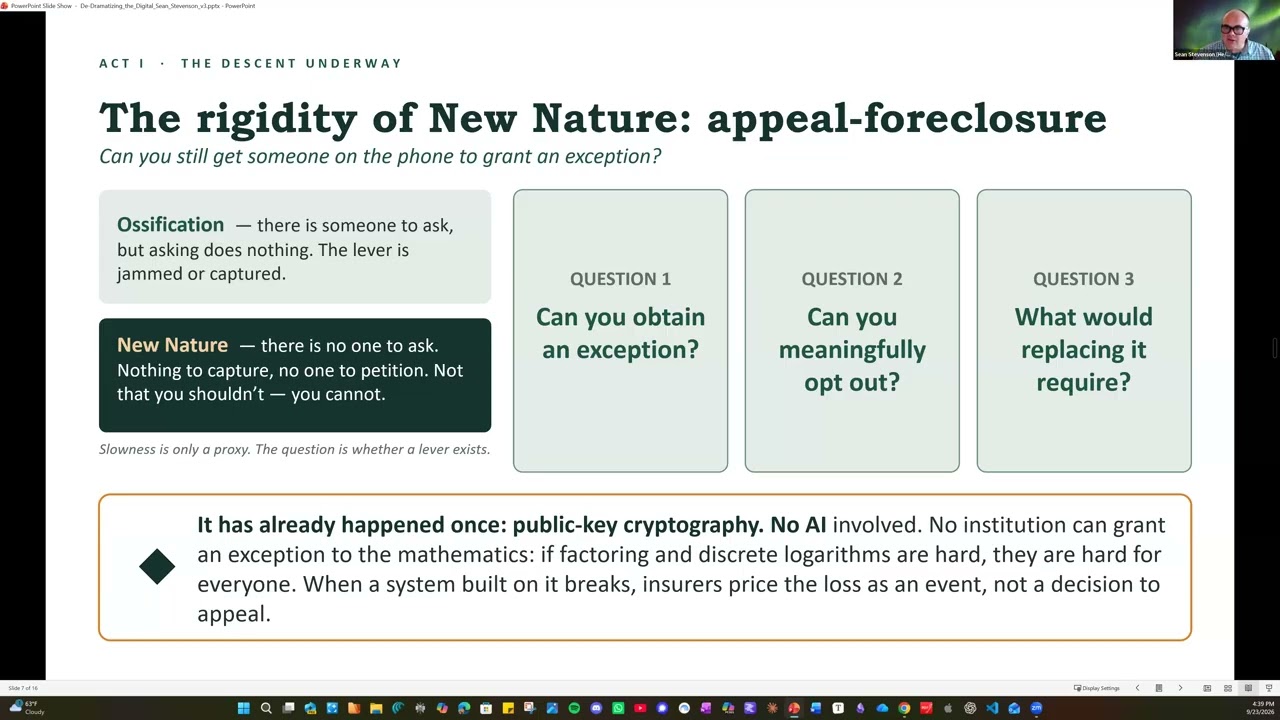
Sean Stevenson argues that AI is undergoing a 'descent' through Stewart Brand's pace layers—moving from fast fashion/commerce layers down through governance and culture toward nature itself—becoming less dramatic and less contestable as it sinks, following a pattern he traces via Clayton Christensen's theory of attractive profits migrating to the least-optimized layer of a value chain. He proposes a four-stage model (integrate, coordinate, embed, inherit) for this descent and introduces 'appeal foreclosure' versus 'ossification' as a way to distinguish genuine new nature from captured systems, while drawing on Spinoza's natura naturans/naturata and Philippe Descola's ontological framework (naturalism, animism, totemism, analogism) to speculate how AI-plus-protocols might shift human categories of inner life and matter.

Related resources

Talk

Open Social Protocols: A Commons-Based Protocol Layer

Jose Leal (with Scott Clearwater) presents Open Social Protocols, a framework built on Needs (recurring coordination conditions) around which communities publish, fork, and adopt Protocols rather than collapsing into single fixed agreements. He describes 'bridging protocols' that let multiple competing protocols for the same need coexist and interoperate, built atop the AT Protocol and a 'Common Ground' layer, citing examples like Morning Star Farms and Buurtzorg as organizations already operating this way without naming it 'protocol'.

Jose Leal, Scott Clearwater

Talk

Protocoling HCI: Hardening Interaction into Infrastructure

Botao Amber Hu presents 'Protocoling HCI,' an early-stage design theory arguing that HCI must shift from designing moments of use to designing protocols as infrastructural material that shapes local action spaces while enabling emergent collective behavior. Drawing on Michael Levine's work on agential material, bioelectric morphogenesis, and 'cognitive glue,' plus concepts like emergent engineering and reverse game theory, Hu proposes that protocols act as 'trust compressors' that let bounded agents coordinate without full mutual knowledge, illustrated through the NFT art piece Merge as a 'protocol art' example.

Botao Amber Hu

Talk

Psychological Safety I & II

Timber Stinson-Schroff argues that AI's workplace effects should be studied through occupational health frameworks rather than existential-risk AI safety, proposing 'cognitive ergonomics' as a better term than 'psychological safety' since it emphasizes chronic, long-term pathologies (like carpal tunnel from typewriters) over acute incidents. Drawing on the safety-one/safety-two distinction from traditional safety literature, Stinson-Schroff advocates crowdsourcing a database of AI usage hazards and pathologies—such as the 'yes man problem' from fast LLM responses and speech pattern changes—toward an eventual diagnostic manual, while cautioning against liability blind spots given the slow, second-order mechanisms by which these harms emerge.

Timber Stinson-Schroff